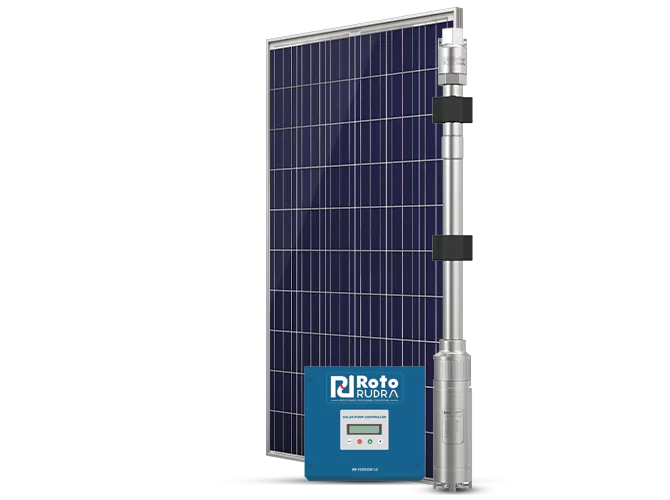
A solar submersible pumping system uses solar PV modules to generate electricity for a motor-pump set installed inside a borewell or open well. The controller optimizes solar power and runs the pump to lift water directly to the surface.
Product Help
Find Answers by Product
Choose a Roto Energy product category and view practical answers for selection, installation, performance, and operation.
13
Products covered
 Solar Submersible Pumping Systems
NEO Series
High-efficiency solar borewell pumping systems for deep well applications
Solar Submersible Pumping Systems
NEO Series
High-efficiency solar borewell pumping systems for deep well applications
 Solar Submersible Pumping Systems
ECO Series
Reliable solar submersible pumps for farms, small landholders, and water supply
Solar Submersible Pumping Systems
ECO Series
Reliable solar submersible pumps for farms, small landholders, and water supply
 Solar Submersible Pumping Systems
Helical Rotor Pumping Systems
High-head pumping systems for deep borewells and low-yield water sources
Solar Submersible Pumping Systems
Helical Rotor Pumping Systems
High-head pumping systems for deep borewells and low-yield water sources
 Solar Submersible Pumping Systems
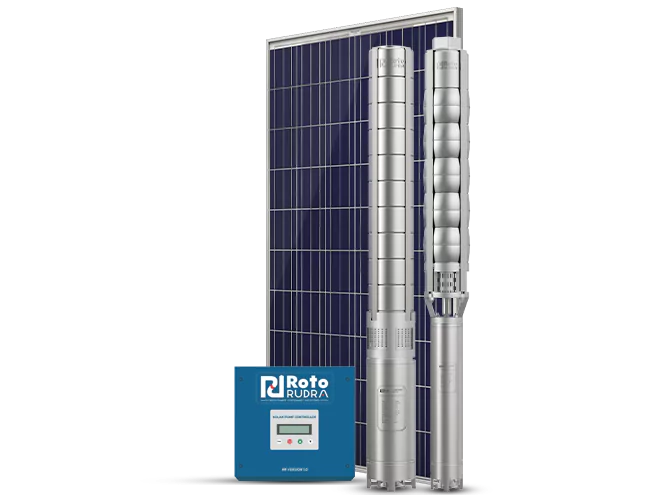
Centrifugal Pumping Systems
High-flow solar pumping systems for irrigation and water supply
Solar Submersible Pumping Systems
Centrifugal Pumping Systems
High-flow solar pumping systems for irrigation and water supply
 Solar Surface Pumping System
s
Portable surface pumps for ponds, canals, tanks, rivers, and shallow sources
Solar Surface Pumping System
Solar Surface Pumping Systems
Portable surface pumps for ponds, canals, tanks, rivers, and shallow sources
 Solar controllers
Solar Controller (Mini)
Compact solar-only controller for small-scale solar pumping
Solar controllers
Solar Controller (Mini)
Compact solar-only controller for small-scale solar pumping
 Solar controllers
Solar Controller (Off-Grid)
Off-grid solar controller for remote water pumping applications
Solar controllers
Solar Controller (Off-Grid)
Off-grid solar controller for remote water pumping applications
 Solar controllers
Solar Controller (Hybrid)
Hybrid controller supporting solar and alternate power operation
Solar controllers
Solar Controller (Hybrid)
Hybrid controller supporting solar and alternate power operation
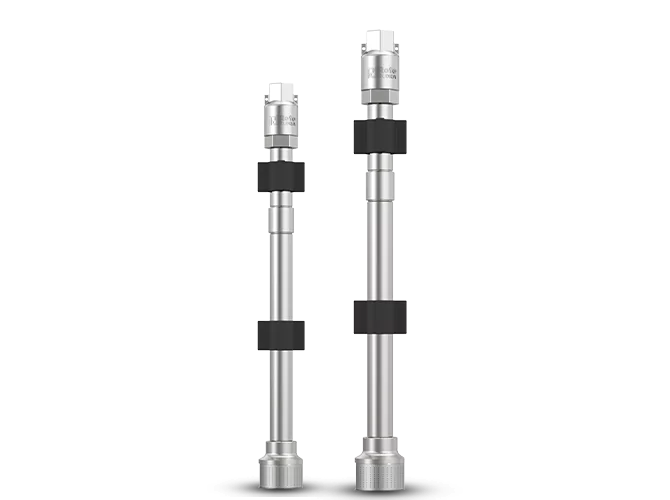 AC DC Submersible Pumps (Stand-Alone)
Helical Rotor Pumps
Stand-alone AC/DC helical rotor pumps for high-head borewell applications
AC DC Submersible Pumps (Stand-Alone)
Helical Rotor Pumps
Stand-alone AC/DC helical rotor pumps for high-head borewell applications
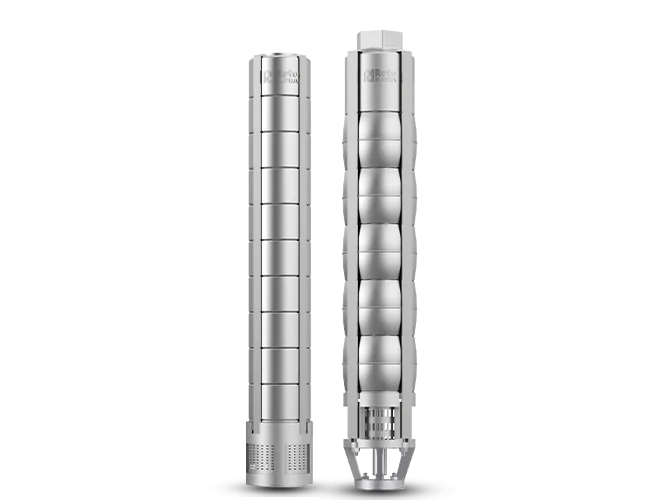 AC DC Submersible Pumps (Stand-Alone)
Centrifugal Pumps
Stand-alone AC/DC centrifugal pumps for high-flow water supply
AC DC Submersible Pumps (Stand-Alone)
Centrifugal Pumps
Stand-alone AC/DC centrifugal pumps for high-flow water supply
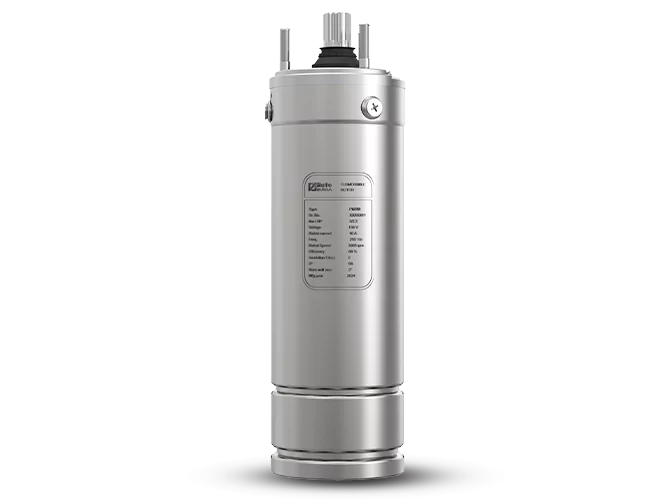 DC Submersible Motors (Stand-Alone)
3" PMSM Motors
Compact PMSM motors for narrow borewell pumping
DC Submersible Motors (Stand-Alone)
3" PMSM Motors
Compact PMSM motors for narrow borewell pumping
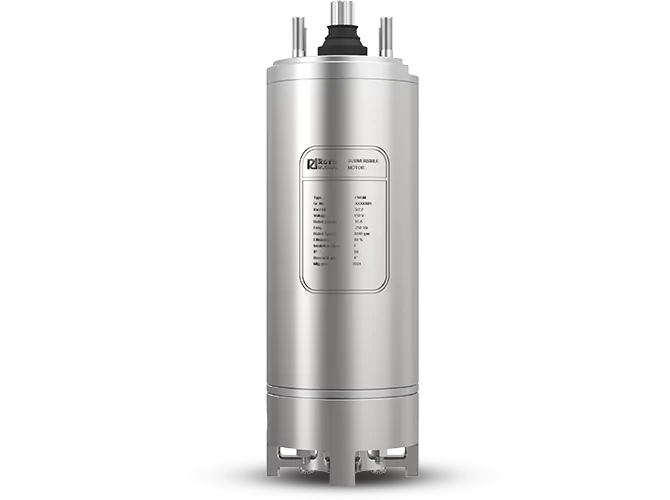 DC Submersible Motors (Stand-Alone)
4" PMSM Motors
PMSM motors for standard borewell solar pumping
DC Submersible Motors (Stand-Alone)
6" PMSM Motors
High-capacity PMSM motors for deep borewell pumping
DC Submersible Motors (Stand-Alone)
4" PMSM Motors
PMSM motors for standard borewell solar pumping
DC Submersible Motors (Stand-Alone)
6" PMSM Motors
High-capacity PMSM motors for deep borewell pumping
No products found
No products available in this category. Please select a different category.
Solar Submersible Pumping Systems
NEO Series
High-efficiency solar borewell pumping systems for deep well applications
Need support? Contact us
Questions and Answers
NEO Series FAQs
NEO Series pumps are built for higher head and higher discharge applications, including deep borewells up to around 250 m dynamic head. ECO Series pumps are designed for budget-conscious farmers and small landholders who need reliable water delivery at medium heads.
Daily output depends on the model, solar irradiation, water level, and head. Smaller models may deliver thousands of litres per day at high head, while higher HP systems can deliver much larger volumes under suitable site conditions.
The required borewell diameter depends on the pump and motor size. Roto RUDRA systems are available for 3-inch, 4-inch, and 6-inch applications, and the borewell casing should match the selected pump model.
Yes. MPPT-based controllers help the pump operate under partial sunlight. Water output may reduce during heavy cloud cover, but the system can continue working when enough solar energy is available.
Roto RUDRA solar submersible systems are available across a broad range, commonly covering agricultural and water supply needs from small HP systems up to high-capacity pumping applications.
A typical system includes solar PV modules, pump and motor, solar controller with MPPT, mounting structure, cables, protection devices, and delivery pipework.
Solar pumps remove fuel cost, reduce maintenance, run automatically during daylight, and provide a cleaner long-term water pumping solution.
Yes. Solar submersible systems can operate fully off-grid using solar energy.
Yes. The controller automatically starts and stops the pump based on available solar energy and protection conditions.
Yes. MPPT control helps maximize operation during lower sunlight periods, though output will depend on available solar radiation.
TDH is the total height and friction losses the pump must overcome to deliver water from the source to the required outlet or storage point.
Important details include borewell depth, static water level, dynamic water level, required daily water quantity, delivery distance, irrigation method, and available space for solar modules.
Yes. Existing borewells can generally be used if the diameter, water level, depth, and site conditions match the selected pump system.
Yes. A 3-inch pump can be installed in a larger casing when the pump assembly and installation conditions are suitable.
Most installations can be completed within one to three days, depending on site readiness, borewell condition, mounting structure, and piping work.
The number of solar panels depends on pump power rating, operating head, required water output, site sunlight, and controller voltage limits.
Yes. Additional panels can be added if the controller voltage and power limits are respected. Extra solar capacity can improve operation during weaker sunlight hours.
Panel distance depends on cable sizing and voltage drop. Proper cable selection is important to keep the system efficient.
Cleaning frequency depends on local dust conditions, but regular cleaning is recommended to maintain sunlight absorption and water output.
Solar panels typically provide long service life, often exceeding 25 years under normal operating conditions.
Expansion may be possible when the pump, controller, solar array, and site requirements are reviewed together and kept within design limits.
Common applications include irrigation, drip irrigation, sprinkler irrigation, livestock watering, drinking water supply, community water supply, pond management, and remote water transfer.
Yes. They are designed for locations with limited or no grid power availability.
Yes. Solar submersible systems are widely used for village and community water supply schemes where dependable off-grid water access is needed.
Routine maintenance mainly includes solar panel cleaning, cable inspection, electrical checks, and periodic pump health checks.
Technical assistance, troubleshooting, maintenance support, and after-sales service are available through the manufacturer and service network.
Solar Submersible Pumping Systems
ECO Series
Reliable solar submersible pumps for farms, small landholders, and water supply
Need support? Contact us
Questions and Answers
ECO Series FAQs
ECO Series pumps are designed for dependable solar water pumping in farms, small landholdings, and medium-head water supply applications.
ECO Series focuses on practical, cost-effective pumping for everyday water needs, while NEO Series is selected for higher-head and higher-duty applications.
Yes. ECO pumps can operate with compatible solar modules and a correctly selected solar pump controller.
They suit irrigation, drinking water supply, livestock watering, gardens, and community water use where the required head and discharge match the selected model.
Routine maintenance includes solar panel cleaning, cable inspection, controller checks, and periodic pump health inspection.
Solar Submersible Pumping Systems
Helical Rotor Pumping Systems
High-head pumping systems for deep borewells and low-yield water sources
Need support? Contact us
Questions and Answers
Helical Rotor Pumping Systems FAQs
A helical rotor pump, also called a progressive cavity pump, uses a rotor and stator to create smooth continuous flow. It is best for deep borewells, high-head pumping, low-yield sources, and steady water delivery.
Centrifugal pumps are best for high-flow and low-to-moderate head applications. Helical rotor pumps are positive displacement pumps and are preferred for very deep borewells, low-yield water sources, and steady flow under high pressure.
Yes. They are designed with robust stator and rotor materials that can handle fine sand and sediment commonly found in agricultural borewells, subject to normal operating limits.
Yes. They can operate with solar modules and a compatible MPPT controller selected according to the pump and motor rating.
Yes. Helical rotor pumps are especially useful for high-head and low-flow applications where consistent lifting is required.
They are suitable for deep borewells, low-yield wells, high-head applications, and sites where steady discharge is more important than very high flow.
The helical rotor range is designed for lower to medium discharge applications. Exact LPM depends on the selected model, head, and solar power configuration.
Helical rotor pumps are available for smaller and standard borewell casings. The required borewell size depends on the pump and motor diameter.
Yes. They are commonly selected for drinking water and domestic supply where the borewell is deep or the water source has limited yield.
Yes. They can support drip irrigation when the required flow, pressure, source condition, and total dynamic head match the selected model.
For many high-head, lower-flow applications, helical rotor pumps can be a more efficient fit than centrifugal pumps. Final sizing depends on the actual head and water demand.
Yes. Helical rotor pumps are generally preferred where water availability is limited and a controlled, steady output is needed.
Routine checks include solar panel cleaning, cable inspection, controller inspection, and periodic pump health checks based on site water quality and operating hours.
Solar Submersible Pumping Systems
Centrifugal Pumping Systems
High-flow solar pumping systems for irrigation and water supply
Need support? Contact us
Questions and Answers
Centrifugal Pumping Systems FAQs
Centrifugal submersible pumps are ideal for high-volume water delivery from borewells, open wells, lakes, and rivers. They are used for farm irrigation, municipal water supply, industrial water management, and domestic water supply.
Yes. When selected correctly, centrifugal systems can provide the flow and pressure required for sprinkler irrigation layouts.
Output depends on pump rating, sunlight, total dynamic head, pipe sizing, water source, and solar array design.
Maintenance is low compared with diesel systems. Routine checks include cleaning panels, inspecting cable connections, checking pipework, and ensuring the pump is free from air locks or dry-run conditions.
Yes. Centrifugal pumps are generally recommended where high water discharge is required for irrigation, transfer, and larger water supply applications.
A centrifugal pump uses impellers to move water and is best for high-flow applications. A helical rotor pump is a positive displacement pump and is better for high-head, lower-flow applications.
For maximum water discharge, a centrifugal pumping system is generally recommended when the head and borewell conditions are suitable.
Centrifugal pumps are designed for medium to high discharge requirements. Exact discharge depends on model, head, solar power, and pipe layout.
Centrifugal pumps commonly require 4-inch borewells and above, depending on the selected pump and motor size.
Yes. Centrifugal systems are suitable for community water supply where higher flow is needed and the water source can support the required discharge.
Stainless steel construction improves durability in demanding water conditions. Water quality should still be checked before final pump selection.
Yes. A centrifugal solar pumping system can run fully on solar power when the pump, motor, controller, and solar array are correctly sized.
Output can reduce due to lower sunlight, higher head than designed, undersized pipework, voltage drop, water level changes, air locks, or dirty solar panels.
Solar Surface Pumping System
Solar Surface Pumping Systems
Portable surface pumps for ponds, canals, tanks, rivers, and shallow sources
Need support? Contact us
Questions and Answers
Solar Surface Pumping Systems FAQs
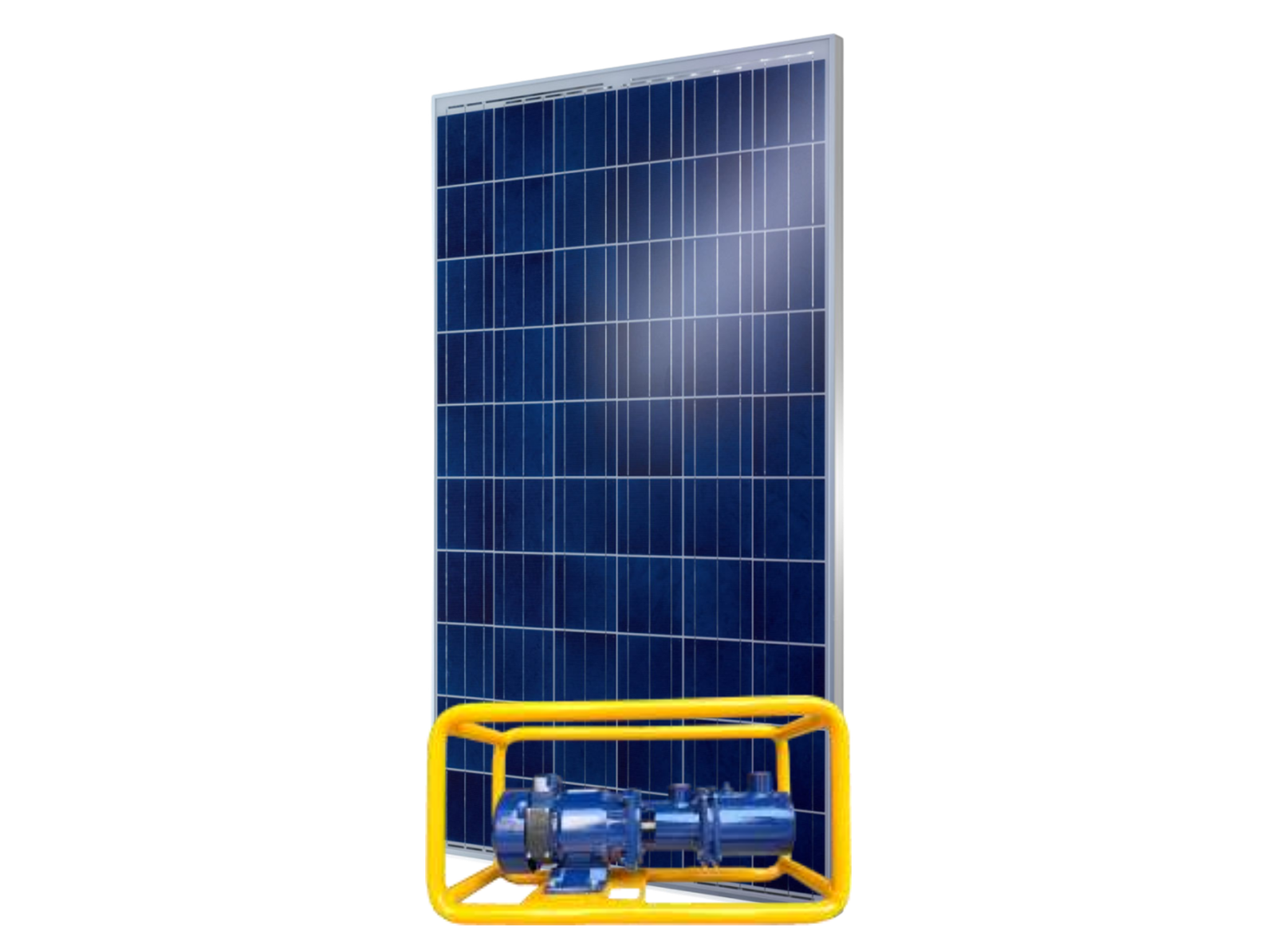
A solar surface pumping system is installed above ground and draws water through suction from sources such as rivers, canals, ponds, tanks, or shallow wells.
A surface pump is installed outside the water source, making it easier to inspect, service, relocate, and reinstall. A submersible pump operates underwater inside a borewell or well.
Yes. Since the pump is installed above ground, it can be dismantled and reinstalled at another site with minimal effort.
Yes. The system can be shifted between ponds, canals, tanks, and similar water sources depending on seasonal water availability.
Not always. Depending on the installation type, portable or semi-permanent mounting arrangements can be used.
Yes. Solar surface pumps are suitable for locations where grid electricity is unavailable or unreliable.
Suction capability depends on the pump model and site conditions. Selection should always be based on actual suction, delivery head, pipe length, and source conditions.
Yes, as long as water level variation remains within the recommended operating range for the selected pump and suction arrangement.
Yes. The MPPT controller adjusts operating parameters to maximize water output under changing sunlight conditions.
The controller automatically adjusts motor speed and pump performance to match the available solar power.
Dry-run protection can automatically stop the pump to help prevent damage.
Yes. The controller enclosure and system components are designed for outdoor agricultural environments, with routine inspection and protection from misuse.
Both are important. Pump selection must match the required flow rate and total dynamic head for the application.
Yes. Properly selected surface pumping systems can provide the pressure and flow required for drip and sprinkler irrigation.
Systems equipped with RMS and connectivity can support remote monitoring, fault alerts, and performance tracking.
No. The system operates using solar energy, so there is no diesel fuel cost.
Solar modules typically provide long service life, often over 25 years, while pump life depends on operating conditions and maintenance practices.
Solar controllers
Solar Controller (Mini)
Compact solar-only controller for small-scale solar pumping
Need support? Contact us
Questions and Answers
Solar Controller (Mini) FAQs
A solar pump controller converts and regulates variable solar power so the pump motor runs efficiently. It also provides MPPT, soft start, dry-run protection, over-voltage protection, under-voltage protection, and other safety functions.
Only Solar controllers run the pump from solar power during daylight. Off-Grid controllers are used where the system must operate without regular grid availability. Hybrid controllers support alternate power sources such as grid power, depending on configuration.
Roto Solar Pump Controllers are available for small domestic systems through high-capacity agricultural, commercial, and industrial pumping systems, with controller selection based on motor HP and application.
Controllers are selected according to pump motor rating. For optimum performance, the controller capacity should match the pump HP, voltage, and operating requirement.
A controller rated for 1 HP operation or slightly above the motor rating is typically recommended, subject to motor voltage and pump configuration.
Only if the controller is designed and rated for both capacities. Always verify the controller maximum supported motor power before installation.
Yes. High-capacity controllers are available for larger agricultural, commercial, community, and industrial applications.
Common agricultural configurations include 3 HP, 5 HP, 7.5 HP, and 10 HP, depending on borewell depth, water demand, pump type, and irrigation method.
Yes. If future expansion is planned, a higher-capacity controller can be selected during system design, provided the complete system remains compatible.
Controller sizing depends on motor HP, motor voltage, pump type, solar array capacity, operating head, and site requirements.
Yes, when the controller is compatible with the selected motor and pump configuration.
Roto controllers are available for high-capacity applications. The correct maximum motor size depends on the controller model and system configuration.
Yes. Smaller controller models are available for household and small-scale water supply applications.
Yes. Higher-capacity controllers can be used for large agricultural, commercial, industrial, and community water pumping applications.
MPPT means Maximum Power Point Tracking. It continuously optimizes power extraction from solar panels to improve pumping performance under changing sunlight.
Yes. Compatible controllers can stop the pump when water is unavailable to help prevent damage.
Typical protections include dry-run, over-voltage, under-voltage, reverse polarity, thermal overload, surge protection, and soft-start functions depending on the controller model.
Yes. Pump speed can be adjusted through compatible controllers according to application requirements.
Selected controller systems offer remote monitoring and system management through mobile and laptop connectivity.
In many cases, a properly selected solar controller can be integrated with a compatible existing pump system, reducing conversion cost. Compatibility must be verified before installation.
Yes, subject to motor compatibility, solar array sizing, and controller selection.
Solar controllers
Solar Controller (Off-Grid)
Off-grid solar controller for remote water pumping applications
Need support? Contact us
Questions and Answers
Solar Controller (Off-Grid) FAQs
It is used where the pump must run from solar power in remote locations without dependable grid electricity.
It manages solar input, MPPT operation, motor control, soft start, and protection functions for the pumping system.
Yes. Compatible off-grid controllers can include dry-run protection to help prevent pump damage when water is unavailable.
Yes. Off-grid solar controllers are commonly used for agricultural borewells, irrigation, livestock watering, and remote water supply.
Selection depends on motor HP, voltage, pump type, solar array size, total dynamic head, and site operating conditions.
Solar controllers
Solar Controller (Hybrid)
Hybrid controller supporting solar and alternate power operation
Need support? Contact us
Questions and Answers
Solar Controller (Hybrid) FAQs
A hybrid controller can operate a compatible pump using solar power and can support alternate power sources such as grid power depending on system configuration.
Choose a hybrid controller when water supply is required beyond strong sunlight hours or where grid-assisted operation is needed.
Yes. When configured with an alternate power source, it can help maintain operation when solar radiation is low.
Compatible controllers can include dry-run, over-voltage, under-voltage, overload, and other protection functions.
Upgrade may be possible if the pump, motor, controller, wiring, and protection system are compatible.
AC DC Submersible Pumps (Stand-Alone)
Helical Rotor Pumps
Stand-alone AC/DC helical rotor pumps for high-head borewell applications
Need support? Contact us
Questions and Answers
Helical Rotor Pumps FAQs
AC/DC stand-alone submersible pumps are pump units that can operate with compatible AC or DC power configurations depending on system design and controller selection.
They are useful for locations with intermittent grid supply or where users want the flexibility to operate with solar during the day and alternate power when available.
Roto RUDRA submersible pumps use stainless steel construction, commonly SS304, with SS316 options available for demanding water conditions.
Helical rotor pumps are best for high-head, low-yield, and deep borewell applications. Centrifugal pumps are best for high-flow irrigation and water transfer applications.
For deep borewells and high-head applications, helical rotor pumps are generally preferred.
For high-volume water requirements, a centrifugal submersible pump is generally recommended.
Helical rotor submersible pumps are available for high-head applications, with model selection based on exact head, discharge, and borewell conditions.
Centrifugal submersible pumps are available for moderate to high-head applications, with selection based on the required discharge and site conditions.
Helical rotor pumps are generally preferred where water availability is limited and lifting head is high.
Helical rotor pumps are available for borewells starting from smaller casings, depending on the selected model and motor size.
Centrifugal pumps commonly require 4-inch borewells and above, depending on model and capacity.
Yes. Existing borewells can be used if the bore diameter, water level, depth, and operating conditions are suitable.
It means the pump can operate with compatible AC or DC power configurations, giving more flexibility in system design.
Yes. They are designed to work with compatible solar pumping solutions and solar controllers.
Grid-assisted operation may be possible with a compatible hybrid controller and suitable pump configuration.
Yes, provided the pump, controller, wiring, and protection system are compatible with hybrid operation.
The pumps are available with high-efficiency PMSM motor configurations for improved performance and energy efficiency.
The 10-pole motor design is intended to improve efficiency, smooth operation, and operational life in solar pumping applications.
Yes. Stainless steel construction improves durability in demanding water conditions, subject to normal water quality limits.
Available protections can include dry-run, reverse polarity, over-voltage, under-voltage, thermal overload, surge protection, and controller-based safeguards depending on system configuration.
Routine maintenance mainly includes periodic pump inspection, cable inspection, controller checks, and cleaning of associated solar components.
RMS-based remote monitoring options are available when supported by the selected controller and connectivity setup.
Deep borewell and high-head applications generally suit helical rotor pumps. High water demand, irrigation, and water transfer generally suit centrifugal pumps.
AC DC Submersible Pumps (Stand-Alone)
Centrifugal Pumps
Stand-alone AC/DC centrifugal pumps for high-flow water supply
Need support? Contact us
Questions and Answers
Centrifugal Pumps FAQs
They are best used for high-flow irrigation, water transfer, domestic supply, and community supply where the borewell or source can support the required discharge.
A centrifugal pump is preferred for higher discharge, while a helical rotor pump is preferred for high-head and lower-yield borewell conditions.
Yes. They can work with compatible solar pumping systems and controllers selected according to motor rating and site conditions.
Centrifugal pumps commonly require 4-inch borewells and above, depending on model, motor size, and capacity.
Routine maintenance includes cable inspection, controller checks, pump inspection, pipework checks, and cleaning associated solar panels when used.
DC Submersible Motors (Stand-Alone)
3" PMSM Motors
Compact PMSM motors for narrow borewell pumping
Need support? Contact us
Questions and Answers
3" PMSM Motors FAQs
3" PMSM motors are used for narrow borewells, compact installations, and lower-yield water sources where efficient DC submersible pumping is required.
They suit compact borewell pumping, small farms, domestic water supply, drinking water projects, and installations where casing diameter is limited.
Yes. A 3" motor can typically be installed in a larger borewell when the pump assembly and installation arrangement are compatible.
Yes. 3" PMSM motors are often useful in narrow or low-yield borewells when paired with the correct pump and controller.
Yes. It can be paired with compatible pump configurations, commonly including helical rotor applications for high-head and lower-flow pumping.
Yes. PMSM motors are well suited for variable-speed solar pumping when operated with a compatible controller.
The controller must match the motor voltage, power rating, pump type, solar array, and site operating head.
PMSM technology supports smooth startup and efficient operation under varying solar power, subject to available sunlight and controller settings.
Maintenance mainly includes electrical checks, cable inspection, controller review, and periodic pump health checks according to site conditions.
Remote monitoring can be supported depending on the complete system configuration, controller, and RMS connectivity.
DC Submersible Motors (Stand-Alone)
4" PMSM Motors
PMSM motors for standard borewell solar pumping
Need support? Contact us
Questions and Answers
4" PMSM Motors FAQs
A 4" PMSM motor is generally preferred for standard 4-inch borewell installations, subject to pump capacity and site requirement.
They are used in standard agricultural, domestic, and water supply borewells where efficient solar pumping is required.
Yes. PMSM motors are designed for compatibility with suitable submersible pump configurations.
Yes. They are widely suited to agricultural borewell pumping, irrigation, drinking water supply, and general water transfer applications.
Yes. They can be integrated into existing borewells when casing size, pump capacity, cable length, water level, and head are suitable.
A 4" PMSM motor can be paired with compatible helical rotor or centrifugal pump sets depending on head and discharge requirements.
Filling options can include oil-filled, water-filled, and resin-filled variants depending on model and site requirement.
A sine-wave filter is generally not required within the recommended cable length and controller configuration. Final requirements should be checked during system design.
Yes. Remote monitoring can be added when supported by the controller and RMS communication setup.
PMSM motors provide higher efficiency, lower losses, smoother operation, better solar utilization, and improved variable-speed performance.
DC Submersible Motors (Stand-Alone)
6" PMSM Motors
High-capacity PMSM motors for deep borewell pumping
Need support? Contact us
Questions and Answers
6" PMSM Motors FAQs
6" PMSM motors are used for high-capacity, deep borewell, commercial, industrial, and community water supply applications.
For high-capacity deep borewell applications, 6" PMSM motors are generally recommended.
Yes. They are suitable for larger pump sets and demanding operating conditions where higher capacity or deeper installation is required.
Yes. They are suitable for high-capacity village, community, commercial, and industrial water supply applications when selected correctly.
6" PMSM motors can be paired with compatible high-capacity submersible pump configurations based on required head and discharge.
Yes. Roto RUDRA PMSM motors are designed for deep submergence and pressure-balanced operation.
Yes. PMSM technology is designed for long-duration pumping when the motor, pump, controller, and site conditions are properly matched.
Filling options can include oil-filled, water-filled, and resin-filled variants depending on model and application.
PMSM design reduces rotor losses, improves power factor, lowers heat generation, and helps the system use available solar energy more effectively.
Remote monitoring can be added when supported by the selected controller and RMS configuration.